The alluvial soils of the Las Vegas valley are a mix of silty sands, gravels, and clays deposited by ancient Lake Mead and the surrounding mountain washes. Groundwater sits deep in most areas, but the presence of caliche layers and expansive clays near the northwest foothills changes how roads perform. A proper CBR study for road design in Las Vegas starts with classifying the soil and running a soaked CBR test at the expected compaction density, because what looks like a solid subgrade at the borrow pit can soften by 30% after a wet season. We typically pair this with a classification of soils to identify fines content and plasticity, and a Proctor test to set the optimum moisture target before the roller gets on site.
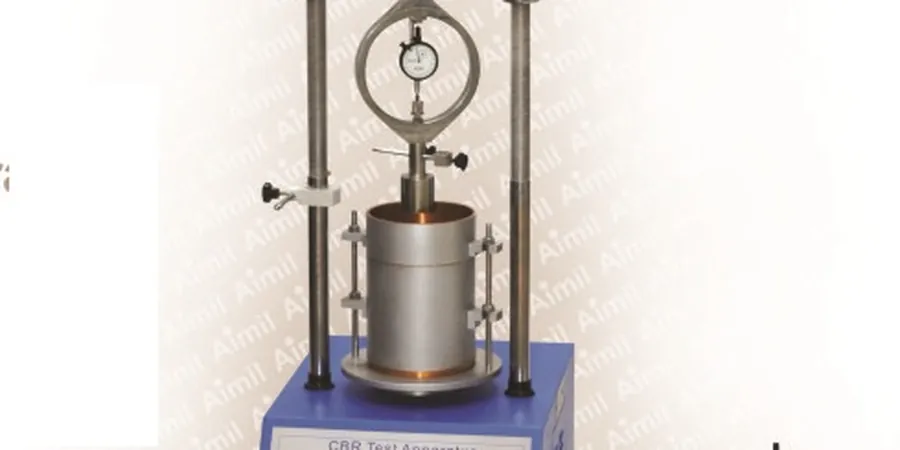
A soaked CBR test reveals the real subgrade strength after moisture intrusion, preventing pavement failures that appear within the first two years of service.
Service characteristics in Las Vegas
Critical ground factors in Las Vegas
Las Vegas grew explosively from the 1990s through the 2000s, pushing development into former wash channels and playa deposits on the edges of the valley. Many subdivisions built on silty subgrades with CBR values below 5 ended up with cracked pavements within three years. The combination of high summer heat and occasional winter rain cycles accelerates fatigue in thin asphalt sections. If the CBR study for road design is done on a single sample from the surface, without checking the variability across the lot, you risk placing a pavement structure that works in one area but fails in another 100 feet away.
Our services
We offer a complete range of services to support the CBR study for road design in Las Vegas, from field sampling to laboratory testing and interpretation.
Disturbed and Undisturbed Sampling
Bulk samples for CBR compaction and bag samples for classification, collected according to ASTM D420 from test pits or boreholes.
CBR Penetration Testing
Soaked and unsoaked CBR tests following ASTM D1883, with swell monitoring and load-penetration curves reported at 0.1 and 0.2 inches.
Soil Classification and Atterberg Limits
Gradation analysis (ASTM D6913) and plasticity index (ASTM D4318) to identify expansive clays that reduce CBR after wetting.
Compaction Characterization
Standard and Modified Proctor tests (ASTM D698 / D1557) to define the moisture-density relationship used for CBR specimen preparation.
Frequently asked questions
What is the difference between soaked and unsoaked CBR?
The soaked CBR test submerges the compacted specimen for four days before penetration, simulating the worst-case moisture condition a subgrade may experience. The unsoaked CBR tests the sample at its original compaction moisture. For road design in Las Vegas, we recommend using the soaked CBR value because even arid environments see moisture from irrigation, storm events, or capillary rise.
How many CBR samples are needed for a typical road project in Las Vegas?
For a single pavement section with uniform soil, three CBR specimens at the same density are standard to get a representative average. If the subgrade varies across the site — for instance, transitioning from alluvial sand to clay near the Red Rock area — we test one set per distinct soil unit. A typical subdivision road might require 6 to 10 CBR tests across the alignment.
What is the typical cost of a CBR study for road design in Las Vegas?
The cost ranges between US$180 and US$350 per CBR test, depending on whether it is soaked or unsoaked and whether classification tests are included. A full package with sampling, three CBR tests, and Atterberg limits typically runs between US$800 and US$1,200. Contact us for a quote specific to your project scope.
Can CBR be estimated from soil classification without testing?
Published correlations exist between CBR and soil type — for example, a well-graded sand (SW) may estimate CBR around 20, while a high-plasticity clay (CH) may estimate below 5. However, these correlations are rough and do not account for compaction effort, moisture content at the time of testing, or the effect of compaction energy. For design, we always recommend laboratory CBR testing rather than relying on estimated values.
What CBR value is needed for a residential street subgrade?
Typical residential street pavement designs in Las Vegas assume a subgrade CBR between 6 and 10 for a 20-year design life. If the CBR falls below 5, the pavement section must be thickened or the subgrade must be stabilized with cement or lime to avoid premature cracking. Our laboratory reports include the measured CBR along with the swell percentage, which helps the pavement designer decide if treatment is necessary.