Las Vegas grew fast after the 1930s, turning desert into a sprawling metropolis. That desert soil — mostly silty sands and alluvial fan deposits — compacts differently than clay-rich ground elsewhere. Engineers here quickly learned that a standard Proctor test isn't always enough. The Modified Proctor, with its higher energy, better simulates the heavy rollers used on highway embankments and large commercial pads. Before specifying compaction targets, a reliable Proctor test in Las Vegas establishes the optimum moisture content and maximum dry density for the local borrow material. Pairing this with a granulometria analysis helps identify the soil's gradation, while a clasificacion-suelos using the Unified System confirms the material type.
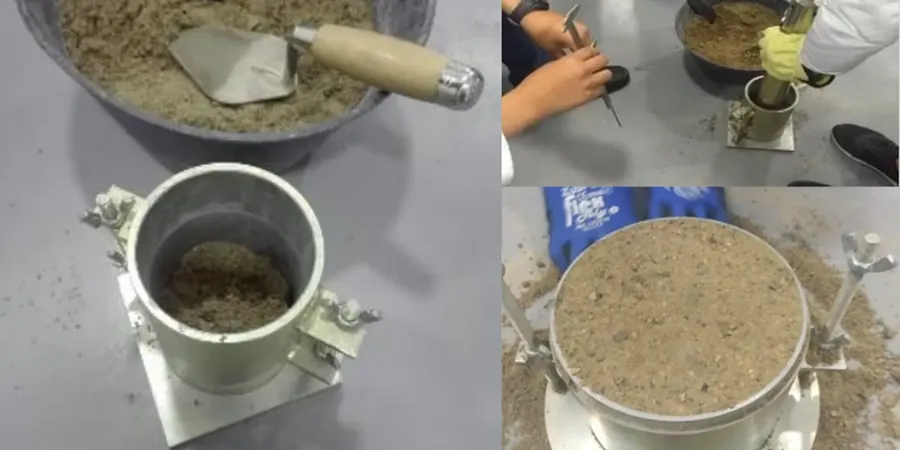
In arid Las Vegas soils, the Modified Proctor often yields a target dry density 5-8% higher than Standard, demanding precise moisture control in the field.
Service characteristics in Las Vegas
Critical ground factors in Las Vegas
A common mistake in Las Vegas is assuming that the Standard Proctor applies to all fills. Builders sometimes use Standard Proctor targets for deep fills under strip malls or residential subdivisions. That leads to under-compaction — the fill settles after construction, cracking slabs and sidewalks. The Modified Proctor is required by most Clark County grading ordinances for fills deeper than 2 feet. Skipping the right Proctor test in Las Vegas means risking differential settlement, especially in areas where alluvial fans contain loose, variable layers. A proper test prevents costly rework.
Our services
We offer two Proctor test variants to match the compaction energy required by your project specifications.
Standard Proctor (ASTM D698)
Uses a 5.5-lb hammer dropped 12 inches over 3 layers. Best for light fills, residential grading, and projects where the field compactor is a small plate tamper or walk-behind roller. Provides the baseline maximum dry density for most single-family home sites in Las Vegas.
Modified Proctor (ASTM D1557)
Uses a 10-lb hammer dropped 12 inches over 5 layers. Required for deep fills, roadway embankments, and commercial pads. The higher energy simulates heavy vibratory rollers and sheepsfoot compactors. Most Clark County grading plans specify Modified Proctor targets for fills over 2 feet deep.
Frequently asked questions
What is the difference between Standard and Modified Proctor tests?
The main difference is compaction energy. Standard Proctor uses a 5.5-lb hammer dropped 12 inches over 3 layers (12,400 ft-lb/ft³). Modified Proctor uses a 10-lb hammer dropped 12 inches over 5 layers (56,250 ft-lb/ft³). Modified Proctor produces a higher maximum dry density and a lower optimum moisture content, representing heavier field compaction equipment.
How much does a Proctor test cost in Las Vegas?
A Standard Proctor test typically costs between US$90 and US$150. A Modified Proctor test ranges from US$120 to US$220, depending on the number of points needed and whether the soil requires retesting. Volume discounts are available for multiple samples from the same project.
Which Proctor test does Clark County require for grading permits?
Clark County requires the Modified Proctor (ASTM D1557) for any fill exceeding 2 feet in depth. For shallow fills under 2 feet, the Standard Proctor may be accepted, but most geotechnical engineers specify Modified to be safe. Always check the current Clark County Grading Ordinance before submitting test results.
How long does it take to get Proctor test results in Las Vegas?
A standard turnaround is 24 to 48 hours after sample receipt. The test itself takes about 4 hours of lab time, plus drying and plotting. If the soil is wet or contains large particles requiring a 6-inch mold, expect 48 hours. Rush service is available for an additional fee.