Las Vegas sits on a mix of alluvial fans, playa deposits, and collapsible soils that shift dramatically across the valley. When we specify geogrid reinforcement for a retaining wall or a steep slope here, we start with ASTM D6637 for tensile properties and IBC 2021 for design loads. The key is matching the geogrid's long-term design strength to the actual foundation conditions. We've seen projects where a biaxial geogrid worked well in the northwest alluvium but a triaxial grid was needed near the Las Vegas Wash due to higher clay content. Before issuing a specification, our lab runs a granulometry test on the onsite material and a direct shear test to check interface friction between soil and grid. That data drives the final spec, not a generic table.
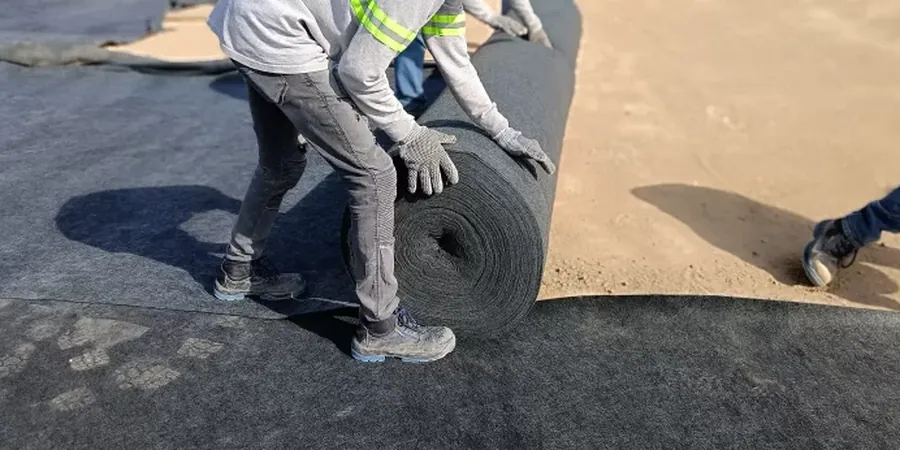
We calibrate every geogrid spec against on-site soil samples and ASTM D6637 tensile tests. A generic table does not hold up in Las Vegas alluvium.
Service characteristics in Las Vegas
Critical ground factors in Las Vegas
I remember a warehouse project near the Strip where the contractor installed a biaxial geogrid without verifying the subgrade CBR. The alluvial sand was loose and saturated after a wet winter. Within six months the access road showed rutting and the retaining wall rotated 4 cm at the toe. We ran forensic tests and found the geogrid had suffered installation damage that reduced its tensile capacity by 40%. The reduction factor for damage had been taken from a conservative table instead of measured. That is why our specification always includes a site-specific pullout test on the actual fill material and a shear strength verification before the geogrid is placed. In Las Vegas, the soil variability between alluvial fans and playa deposits demands that level of detail.
Our services
We deliver complete geogrid specification packages, from material selection to installation verification. Our lab is accredited under ISO 17025 and we follow ASTM and AASHTO standards for every test.
Uniaxial geogrid specification for walls and slopes
For mechanically stabilized earth walls and steep slopes in Las Vegas, we specify uniaxial geogrids with tensile strengths from 40 kN/m to 200 kN/m. We calculate reduction factors based on the site's alluvial or playa soil conditions and verify the connection strength to the facing system.
Biaxial geogrid specification for base reinforcement
On road bases, parking lots, and working platforms in Las Vegas, biaxial geogrids improve load distribution and reduce aggregate thickness. Our specification includes aperture size, junction efficiency, and long-term creep behavior per ASTM D5262. We also verify subgrade CBR and moisture content.
Triaxial geogrid specification for soft subgrades
When the subgrade is silty clay or low-density alluvium, triaxial geogrids provide isotropic confinement. We specify the radial tensile strength at 0.5% strain and check the junction efficiency. This is common near the Las Vegas Wash and in the southeast Henderson area.
Geogrid pullout and interface shear testing
Before finalizing the geogrid specification, we run pullout tests in our lab using the actual project fill and the proposed geogrid. We also measure interface friction between the grid and the soil with a large-scale direct shear box. These tests give the contractor reliable design values.
Frequently asked questions
What is the difference between uniaxial and biaxial geogrids for Las Vegas soils?
Uniaxial geogrids have high tensile strength in one direction and are used for vertical walls and steep slopes where the main load is horizontal. Biaxial geogrids have balanced strength in both directions and work best for base reinforcement under roads and pads. In Las Vegas, the choice also depends on the soil type: alluvial sands usually work well with biaxial, while silty clays near the Wash may need triaxial for isotropic confinement.
How much does a geogrid specification package cost in Las Vegas?
A full geogrid specification package, including material selection, reduction factor calculations, and interface shear testing, typically ranges between US$380 and US$1,320. The final cost depends on the number of geogrid types tested, the complexity of the soil conditions, and whether pullout tests are required. We provide a detailed quote after reviewing the project plans and soil data.
Do you verify the geogrid installation after the spec is delivered?
Yes, we offer field verification services. Our technicians check that the geogrid rolls match the specified tensile strength, that overlaps and connections are correct, and that the subgrade is compacted to the required density. We also take witness samples for tensile testing if there is concern about installation damage. This is especially important in Las Vegas because the alluvial soil can be abrasive on the geogrid ribs.