ASTM D1883-16 sets the standard for laboratory California Bearing Ratio testing. In Las Vegas, this method is critical because the valley floor is dominated by alluvial deposits and caliche layers. These materials behave very differently under load compared to natural soil profiles elsewhere. The dry climate of Las Vegas also means subgrade moisture content can be well below optimum, which directly affects CBR values. Before running the test, we often coordinate with a granulometric analysis to classify the soil fraction and ensure representative compaction. Our lab follows strict sample conditioning protocols to account for the arid conditions typical of southern Nevada. Getting the CBR right here means the difference between a road that lasts a decade and one that fails in two years.
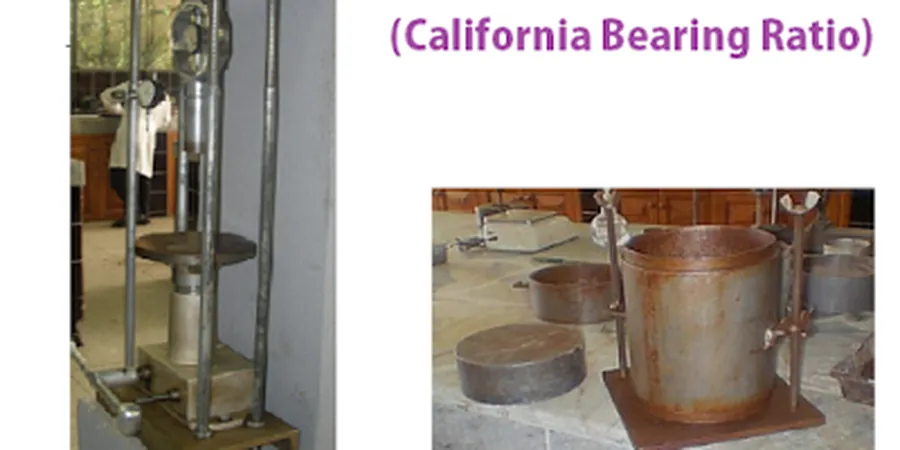
The CBR test is the only reliable way to quantify subgrade support for flexible pavements in Las Vegas alluvial soils.
Service characteristics in Las Vegas
- Force vs. penetration at 1.27 mm increments up to 12.7 mm
- Corrected CBR value at 2.54 mm and 5.08 mm penetration
- Expansion after 96 hours of soaking (critical for Las Vegas where occasional flash floods saturate soils)
- Moisture content before and after soaking
Critical ground factors in Las Vegas
Las Vegas receives less than 4 inches of rain annually, but when it rains, it pours. The problem is that most subgrade soils here are compacted dry of optimum. A single desert thunderstorm can saturate the top 12 inches overnight. Without a soaked CBR test, you have no idea how the subgrade will behave after a heavy downpour. We have seen projects where the dry CBR was 40 and the soaked CBR dropped to 8. That is a 80% loss in bearing capacity. Ignoring this risk leads to pavement rutting, cracking, and premature failure. The soaked CBR value should always be the design parameter, not the unsoaked one. It is a simple precaution that saves enormous repair costs later.
Our services
We offer three complementary CBR-related services tailored to Las Vegas conditions. Each is designed to give you a complete picture of subgrade performance before you pour a single yard of asphalt.
Standard Soaked CBR Test
Four-day soaking period with surcharge weight applied. Expansion measured daily. Penetration test performed on saturated specimen. Reported as corrected CBR at 0.1 and 0.2 inches.
Unsoaked CBR Test (Quick Turnaround)
Same compaction and penetration procedure but without soaking. Results available in 48 hours. Useful for preliminary screening or when moisture conditions are known to be stable.
CBR with Proctor Correlation
We run a full Proctor compaction curve (ASTM D698 or D1557) on the same material. Then we compact CBR specimens at 95%, 100%, and 105% of maximum dry density to generate a CBR vs. density curve for design.
Frequently asked questions
How does the laboratory CBR test work in Las Vegas soils?
A representative soil sample is compacted into a 6-inch mold at a specified moisture content and density. The mold is soaked for 96 hours to simulate worst-case saturation. Then a steel plunger is pushed into the sample at a rate of 1.27 mm/min, and the force required is recorded. This force is compared to a standard crushed rock value to calculate the CBR percentage.
What is the cost range for a laboratory CBR test in Las Vegas?
The typical cost for a standard soaked CBR test with one point compaction ranges between US$130 and US$220. This includes sample preparation, 96-hour soaking, penetration test, and a detailed report with moisture and density data. Additional compaction points or duplicate samples increase the price.
Why is soaked CBR more important than unsoaked CBR in Las Vegas?
Las Vegas soils are typically compacted dry of optimum due to the arid climate. When summer thunderstorms saturate the subgrade, the bearing capacity can drop by 50 to 80 percent. The soaked CBR test simulates this worst-case condition. Using unsoaked values for pavement design in Las Vegas is risky and leads to early failure.