The soils beneath Summerlin and the historic downtown Las Vegas corridor could not be more different. Summerlin sits on well-graded sands and gravels with low plasticity, while downtown and areas near the Las Vegas Wash expose fat clays (CH) that can swell and shrink. For any foundation or pavement project, the unconfined compression test (UCS) becomes essential in those clay-dominated zones. We run the UCS at our local laboratory to measure undrained shear strength quickly, following ASTM D2166-16. The test works best on cohesive, saturated samples – precisely what you encounter in many Las Vegas residential subdivisions. Before designing footings, we often recommend pairing the UCS with a corte directo to capture drained parameters as a cross-check.
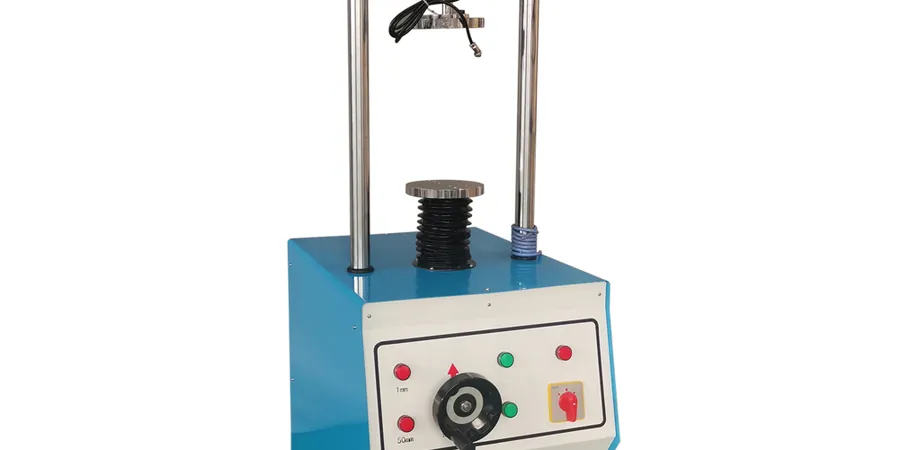
In Las Vegas clays, a single UCS test can reveal strength drops of 40% after wetting. Design accordingly.
Service characteristics in Las Vegas
- Qu (unconfined compressive strength) in psf or kPa
- Su (undrained shear strength) as Qu/2
- Strain at failure (%)
- Stress-strain curve for modulus estimation
Critical ground factors in Las Vegas
Many Las Vegas projects fail to account for strength loss after wetting. When a seasonal storm hits, the unsaturated clays in the vadose zone become saturated, and the unconfined compression test (UCS) results that were run on dry samples become dangerously optimistic. We have seen retaining walls tilt and slabs crack because the design assumed Su values from dry-season testing. Our approach: run UCS at both natural moisture content and after controlled saturation (ASTM D2166 with wetting). This gives you a lower-bound envelope. For deep excavations in the Las Vegas Valley, we also combine the UCS with a estabilidad-taludes analysis to verify factor of safety under worst-case moisture conditions.
Our services
We provide a complete unconfined compression test (UCS) package tailored to Las Vegas soil conditions. All tests run under ISO 17025 accreditation.
Standard UCS on Tube Samples
Using 3-inch or 2.8-inch thin-walled tubes from ASTM D1587 sampling. We trim, saturate if needed, and load to failure. Report includes stress-strain curve and Qu value.
UCS on Block Samples
For stiff clays where tube sampling disturbs the soil, we cut block samples from test pits. Preserves natural fabric. Ideal for fissured clays common in Las Vegas.
Wet-Strength UCS (Saturation Cycle)
Samples are saturated under vacuum before testing. This simulates the worst-case moisture condition after heavy rain. Critical for slab-on-grade and retaining wall design.
Multi-depth UCS Profile
We test samples from every 5 feet of a boring to build a strength vs. depth profile. Helps identify weak layers and verify bearing strata for shallow foundations.
Frequently asked questions
What is the unconfined compression test (UCS) and when is it used?
The UCS test measures the undrained shear strength of cohesive soil by loading an undisturbed cylindrical sample axially with no lateral confinement. It is used for clay and silt soils in applications such as foundation bearing capacity, slope stability, and pavement subgrade evaluation. In Las Vegas, it is especially relevant for fat clays (CH) in the downtown and valley floor areas.
How much does a UCS test cost in Las Vegas?
A standard unconfined compression test (UCS) in our Las Vegas laboratory ranges from US$320 to US$460 per sample. The cost depends on whether saturation is required, the number of samples, and the reporting detail. We provide a firm quote after reviewing the project scope.
What is the difference between UCS and triaxial compression tests?
The UCS test applies no confining pressure, so it only works for saturated cohesive soils where undrained conditions apply. Triaxial tests (ASTM D2850 or D4767) apply a confining pressure, allowing you to measure both drained and undrained strength parameters (c', phi'). For granular soils or when effective stress analysis is required, triaxial is necessary. UCS is faster and cheaper for preliminary clay strength estimates.
How long does it take to get UCS test results?
For standard UCS tests, we deliver results within 24 to 48 hours after sample receipt. If wet-strength testing (saturation cycle) is requested, turnaround extends to 72 hours. We prioritize urgent projects for Las Vegas contractors.