The contrast between the dry basin floor and the surrounding mountain ranges defines Las Vegas, and that same contrast extends underground. The alluvial fans that built this valley deposited gravelly sands and silts with intermittent caliche layers that can stop a pile mid-drive. We have seen projects where refusal occurred unexpectedly at 15 feet because a cemented calcium carbonate horizon was not identified during preliminary exploration. For this reason, driven pile design here must account for both end-bearing in dense granular strata and the risk of premature refusal against caliche. Before finalizing the foundation scheme, we often recommend a corte directo test on the caliche to assess shear strength, and a placa de carga to verify stiffness at the bearing depth. Understanding the variable soil profile across different neighborhoods is the first step toward a reliable driven pile design in Las Vegas.
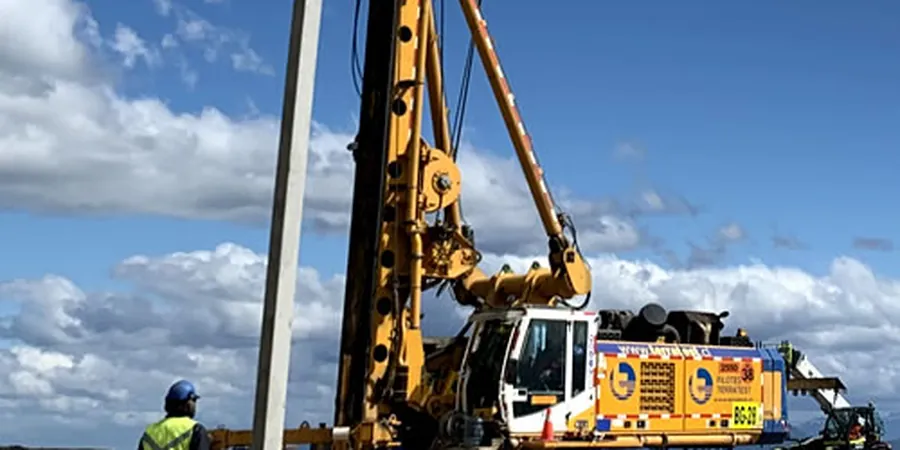
Caliche layers in Las Vegas alluvium can cause premature pile refusal; identifying their depth and thickness before driving prevents costly redesign.
Service characteristics in Las Vegas
Demonstration video
Critical ground factors in Las Vegas
Las Vegas sits within a moderate seismic region, with peak ground accelerations ranging from 0.2g to 0.3g under IBC 2021 site class D. The combination of deep alluvial deposits and a shallow groundwater table in parts of the valley increases the risk of liquefaction in loose sands below the water table. During the 1992 Little Skull Mountain earthquake (M5.6), minor liquefaction effects were observed in the Las Vegas Wash area. A driven pile design in Las Vegas must consider downdrag from post-liquefaction settlement, lateral spreading loads, and potential strength loss in the bearing layer. We perform site-specific liquefaction analyses using NCEER (Youd-Idriss 2001) procedures and adjust pile capacities accordingly.
Our services
Our geotechnical team offers a full suite of services to support driven pile design in Las Vegas, from field exploration to final capacity recommendations.
Field Exploration & SPT
Boreholes with Standard Penetration Testing to characterize soil strata, identify caliche layers, and obtain N-values for shaft and toe resistance calculations.
Laboratory Soil Testing
Gradation, Atterberg limits, direct shear, and triaxial tests on undisturbed and bulk samples to derive strength and stiffness parameters for design.
Drivability Analysis
Wave equation analysis (WEAP) to predict driving stresses, hammer performance, and pile capacity versus depth, reducing the risk of damage or refusal.
Seismic & Liquefaction Assessment
Site-specific ground response and liquefaction potential evaluation using Youd-Idriss SPT-based methods, with recommendations for lateral load resistance.
Frequently asked questions
What is the typical cost range for a driven pile design study in Las Vegas?
For a standard commercial project in Las Vegas, the cost of a driven pile design study including field exploration, lab testing, and analysis typically falls between US$1,440 and US$4,070. The final price depends on the number of borings, depth of exploration, and laboratory work required.
How deep do driven piles usually go in Las Vegas alluvium?
Pile depths vary widely depending on the site. In areas with dense gravels and low groundwater, piles may achieve required capacity at 20 to 40 feet. Where loose sands or deeper caliche layers are present, depths of 50 to 70 feet are common to reach competent bearing strata below the cemented horizons.
Is a static load test required for driven piles in Las Vegas?
The IBC 2021 code requires at least one static load test per project unless a qualifying Pile Load Test program is implemented. We typically recommend one test per 100 piles for initial production, with additional tests if soil conditions vary significantly across the site.
What is the difference between end-bearing and friction piles in Las Vegas soils?
In Las Vegas, end-bearing piles transfer load to dense gravel or caliche layers at depth, while friction piles rely on shaft resistance in the granular alluvium. Most designs combine both mechanisms. Friction piles are more common where caliche is absent or too thin, and end-bearing piles are used where cemented horizons provide a hard stratum at moderate depth.