Las Vegas grew fast from a rail stop to a metropolis on alluvial fans and dry lake beds. The valley floor sits on basin-fill deposits that can amplify ground motion in unexpected ways. When the first casinos went up in the 1940s, few engineers thought about deep soil resonance. Today we know that a building’s height and the soil’s natural frequency must not align. That is where the HVSR microtremor survey (Nakamura method) becomes essential. It measures ambient vibration to find the fundamental resonance frequency of the soil column. We combine this with a [MASW survey](/masw-vs30/) to map shear-wave velocity profiles and a georadar survey to detect shallow anomalies before final design. The result is a site-specific seismic classification that helps structural engineers tune the building to the ground, not against it.
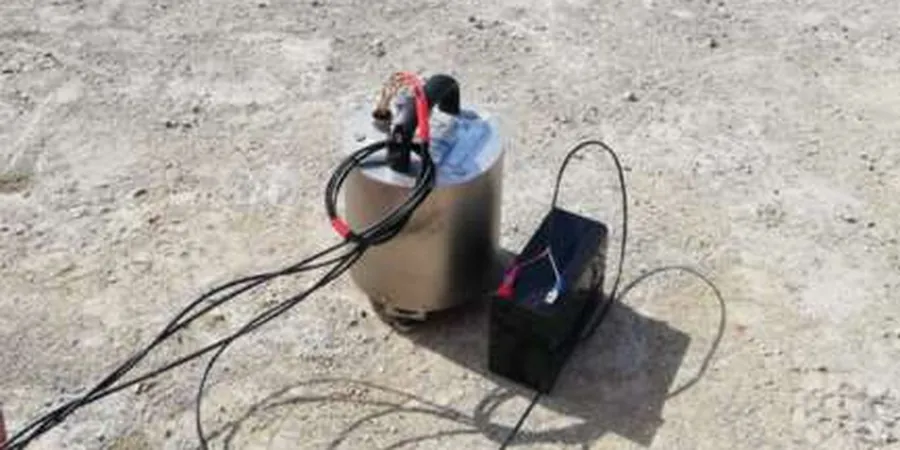
A 30-minute ambient vibration recording reveals the soil's natural frequency with enough precision to avoid resonance with a 10-story building.
Service characteristics in Las Vegas
Critical ground factors in Las Vegas
Las Vegas sits in a seismically active region with the Nevada Seismic Belt to the west and the Intermountain Seismic Belt to the east. The dry climate creates a false sense of stability — loose, dry sands can liquefy when saturated by a broken water main during shaking. The HVSR microtremor survey identifies zones where the soil column amplifies long-period waves, which directly affects mid-rise and high-rise structures. Ignoring this data can lead to buildings that sway more than code allows, increasing repair costs after every tremor. We use the results to assign the correct site class per ASCE 7 and to recommend whether a site-specific response spectrum is needed.
Our services
We offer two complementary HVSR-based services tailored to different project stages and budget levels.
Single-Station HVSR Survey
One to three measurement points per site. Ideal for preliminary seismic screening or small lots. Includes field recording, H/V processing, and a brief report with f0 and amplification factor. Turnaround: 2 business days.
Multi-Array HVSR + MASW Integration
Six or more stations arranged in a grid or transect. Combines HVSR results with active-source MASW to produce a 2D Vs profile. Final report includes site class per ASCE 7, depth to bedrock estimate, and recommendations for site-specific response spectrum analysis. Turnaround: 5 business days.
Frequently asked questions
What is the difference between HVSR and a standard SPT boring for seismic design?
SPT borings give you layer-by-layer soil strength and type at discrete depths. HVSR measures the dynamic response of the entire soil column continuously from surface to bedrock. For seismic design you need both: SPT for liquefaction triggering analysis and HVSR for site resonance period and amplification. They are complementary, not interchangeable.
How long does an HVSR microtremor survey take in the Las Vegas area?
Field time is typically one to two hours per station. A standard three-point survey takes half a day including setup and teardown. Processing and reporting add another one to two days. Total turnaround is usually two to five business days depending on the number of stations.
What is the cost range for an HVSR microtremor survey in Las Vegas?
The typical cost for a single-station HVSR survey in Las Vegas ranges between US$1,560 and US$2,890. Multi-station projects with integrated MASW run higher due to more equipment and processing time. Exact pricing depends on site access, number of stations, and reporting depth. Contact us for a quote tailored to your lot.
Can HVSR replace the need for a site-specific response spectrum analysis?
No. HVSR provides the fundamental frequency and amplification factor, which are key inputs for a response spectrum analysis, but it does not replace the full analysis. You still need a Vs profile (from MASW or SCPT) and a bedrock motion model to generate the design spectrum. HVSR makes the analysis more accurate by constraining the site period.