The contrast between the alluvial fans of Summerlin and the karst-prone limestone beneath downtown Las Vegas is a constant challenge for grouting design. In Summerlin, we encounter loose, collapsible sands that require low-mobility grouting to densify without fracturing the matrix, while downtown fractured carbonates demand high-mobility chemical grouts to seal flow paths. Our approach always starts with a site-specific characterization — a classification of soils to identify collapsible layers, paired with permeability testing in the field to map void networks before any injection begins. Without these data, grouting design becomes guesswork. In Las Vegas, where groundwater depth fluctuates with drought cycles and recharge events, the injection parameters must account for both dry and saturated conditions within the same formation.
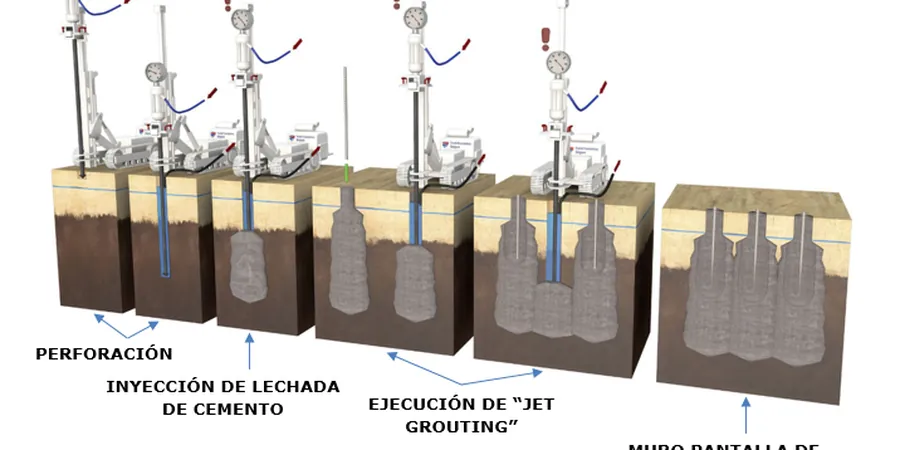
In Las Vegas, grouting design must anticipate both the dry collapsibility of alluvial fans and the fracture flow of buried carbonate rock.
Service characteristics in Las Vegas
- Subsurface profiling via CPT and SPT to map void ratios and fines content
- Selection of grout type — cementitious, chemical, or polyurethane — based on soil gradation and permeability
- Design of injection pressure and volume limits to avoid hydrofracture in loose sands
- Verification testing using plate load tests and pressuremeter after injection
- Long-term monitoring of settlement with survey points
Critical ground factors in Las Vegas
The IBC and ASCE 7 require that grouting design for Las Vegas projects account for site class D or E soils under seismic loading, where loose sands can liquefy even under moderate shaking. Our grouting designs specifically target zones where collapsible soils exceed 10% strain at overburden pressure, or where void ratios exceed 0.8 in the top 30 feet. We incorporate a factor of safety of 1.5 against hydrofracture during injection, per the ASCE Grouting Committee guidelines. Without this approach, a grouting program in Las Vegas risks creating preferential flow paths rather than uniform improvement, leaving critical building corners untreated.
Our services
Our team offers two complementary grouting design services tailored to Las Vegas geology:
Compaction Grouting Design
For loose alluvial sands in areas like the Las Vegas Valley, we design compaction grouting programs using low-slump cementitious grout. Injection points are spaced at 5–8 feet on centers, targeting refusal pressures of 200–400 psi to achieve relative densities above 70%.
Permeation Grouting Design
In fractured limestone or karst zones beneath downtown Las Vegas, we specify high-mobility chemical grouts with viscosities below 50 cP. Our design uses a stage-injection approach with packers, monitoring Lugeon values drop below 1 before moving to the next stage.
Frequently asked questions
What is the difference between compaction grouting and permeation grouting?
Compaction grouting uses a stiff, low-slump cementitious grout to densify loose soils by displacing the matrix, while permeation grouting injects a low-viscosity chemical grout into void spaces without disturbing the soil structure. We select the method based on the soil's relative density and permeability — compaction for loose sands (Dr < 50%) and permeation for fractured rock or clean gravels.
How much does a grouting design study cost in Las Vegas?
The typical cost for a grouting design study in Las Vegas ranges between US$1,410 and US$4,590, depending on the number of injection stages, depth of treatment, and verification testing required. This includes site characterization, injection parameter calculation, and a final report with pressure and volume limits.
How do you determine injection pressure limits for grouting in desert soils?
Injection pressure limits are calculated based on overburden stress and soil shear strength. We apply a factor of safety of 1.5 against hydrofracture using the formula P_max = 2 * sigma_h + cohesion, with sigma_h estimated from CPT sleeve friction. For Las Vegas alluvial sands, we typically limit pressures to 0.5–2.0 psi per foot of depth.
What verification tests confirm grouting effectiveness?
We use pressuremeter modulus (E_p) tests before and after injection to measure stiffness gain, plus plate load tests to verify settlement under design loads. For curtain grouting, we perform Lugeon tests in verification boreholes to confirm permeability reduction below 1 Lugeon unit.