Our Las Vegas lab receives samples directly from job sites across the valley – from the alluvial fans of Red Rock to the playa clays near Nellis. The technician first logs the sample visually under ASTM D2488, noting color, odor, and particle shape. Then we run sieves and hydrometer tests to separate gravel, sand, silt, and clay fractions. For fine-grained soils, we determine Atterberg limits (ASTM D4318) to find the liquid limit and plasticity index. That data feeds directly into the USCS chart or AASHTO classification table. Before we assign a group symbol, we also check for organic content by loss on ignition. Every step follows a chain of custody that meets ISO 17025 requirements. The final report includes the group name, AASHTO class, and a brief description of engineering properties relevant to Las Vegas projects.
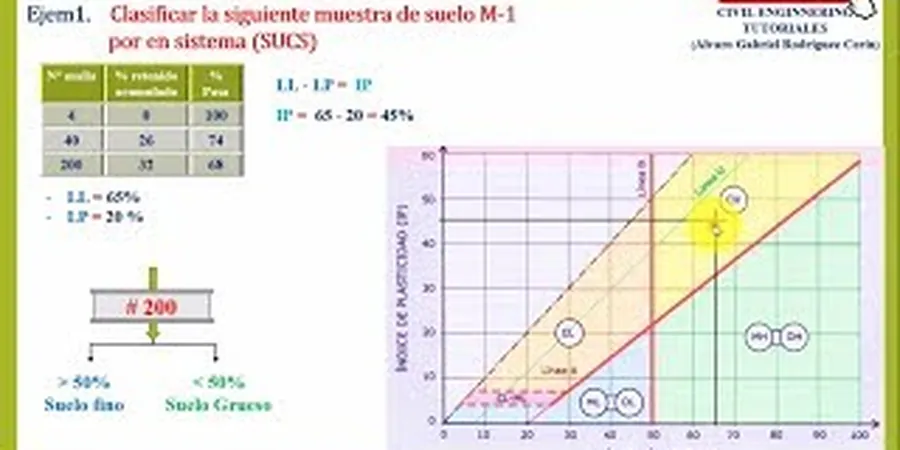
USCS group symbol SM (silty sand) covers over 60% of Las Vegas alluvial deposits – a key fact for compaction and bearing capacity.
Service characteristics in Las Vegas
- Grain-size distribution by ASTM D6913 (sieving) and ASTM D7928 (hydrometer).
- Atterberg limits on the fraction passing No. 40 sieve.
- Group index calculation per AASHTO M 145.
- Moisture content and dry density correlation.
Critical ground factors in Las Vegas
Las Vegas averages less than 4 inches of rain per year, but when it rains, it pours – flash floods carry coarse material into low-lying areas. That sudden change in soil profile can mislead a classification if the sample is taken right after a storm. The dry climate also causes near-surface soils to be highly desiccated, with cracks that alter the apparent plasticity. If the lab receives a sample with high moisture content from a deep borehole, the classification may differ from the same soil at the surface. We flag these anomalies in the report. In areas with expansive clays (CH group), ignoring the swell potential leads to slab heave. The USCS classification alone does not capture swell; we cross-reference with Atterberg limits and free-swell tests.
Our services
We offer three focused soil classification services for Las Vegas projects, from residential lots to large commercial developments.
USCS Classification – Full Lab Profile
Complete USCS soil classification including visual description, sieve analysis, hydrometer, and Atterberg limits. Report includes group symbol, group name, and engineering judgment notes for local conditions.
AASHTO Classification for Pavement Design
AASHTO group index and subgrade classification per M 145. Ideal for road projects in Las Vegas – from subdivisions to the I-15 corridor. Includes R-value estimation.
Field Verification & Sample Collection
Our field technicians collect disturbed and undisturbed samples across Las Vegas. We log each sample location, depth, and field moisture. Samples are sealed and delivered to the lab within 24 hours.
Frequently asked questions
What is the difference between USCS and AASHTO soil classification?
USCS (ASTM D2487) groups soils by grain size and plasticity – symbols like SM, CL, or GW – and is used worldwide for geotechnical design. AASHTO (M 145) focuses on pavement subgrade performance, assigning a group index from A-1 to A-7. In Las Vegas, we often run both: USCS for foundation design, AASHTO for road base specs. The same sample can have a USCS group SM (silty sand) and an AASHTO group A-2-4 with group index 0.
How much does a soil classification test cost in Las Vegas?
The price for a standard USCS/AASHTO classification in Las Vegas ranges from US$60 to US$90 per sample. This includes sieve analysis, hydrometer, and Atterberg limits. Volume discounts apply for projects with ten or more samples. Rush service (24-hour turnaround) adds a small surcharge.
What Las Vegas soil types are most common in USCS classification?
Over 60% of Las Vegas alluvial soils classify as SM (silty sand) or SP-SM (poorly graded sand with silt). In the northwest near the Sheep Range, you find coarser GW (well-graded gravel) and GP (poorly graded gravel). In the valley floor near the Strip and downtown, clay lenses (CL and CH) appear, often with gypsum deposits. The USCS classification helps identify these layers before foundation design.