The Mojave Desert climate that surrounds Las Vegas subjects near-surface soils to extreme drying cycles, yet the region's alluvial fan deposits can contain fine-grained layers that drastically alter subsurface drainage. When designing infiltration basins, retaining walls, or slab-on-grade foundations in Clark County, a laboratory permeability test (falling/constant head) provides the saturated hydraulic conductivity values needed to model seepage rates. Unlike field tests that sample a larger volume but are harder to control, the lab setup isolates a remolded or undisturbed specimen under a known gradient. For projects near the Las Vegas Wash or on the valley floor, where silty sands and low-plasticity clays are common, these tests are often paired with a compaction test to correlate density with permeability and with sieve analysis to confirm grain-size distribution that governs flow behavior.
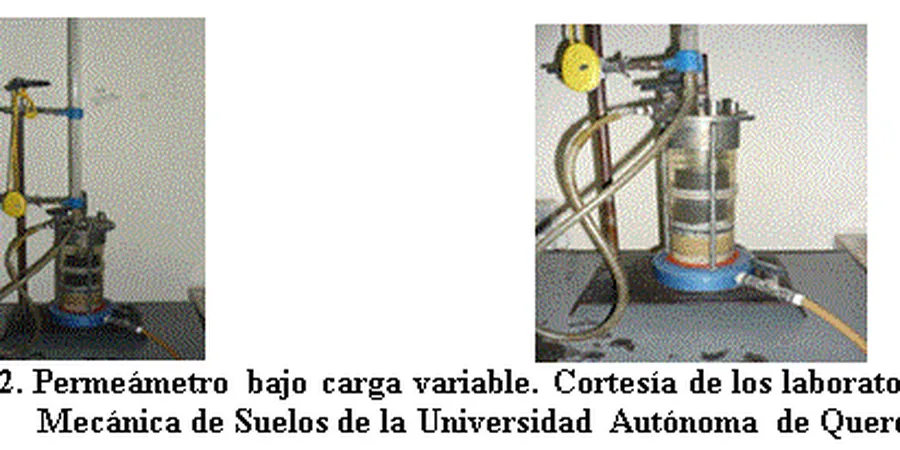
Falling head tests on Las Vegas silty sands typically yield permeabilities between 10⁻⁴ and 10⁻⁶ cm/s, values critical for infiltration basin design.
Service characteristics in Las Vegas
Critical ground factors in Las Vegas
In Las Vegas, the most common mistake is assuming that the dry, loose surface soils are representative of deeper, compacted layers. A test on a near-surface sample may show high permeability, while the underlying alluvial fan material, often cemented by calcium carbonate (caliche), can be virtually impervious. This mismatch has led to undersized retention basins and slab heave in several master-planned communities. Another risk is testing at a single moisture content when the site will experience seasonal irrigation or storm events. The lab must simulate the expected field saturation state; otherwise, the design permeability may be off by a factor of ten. For fills placed on steep lots west of the Strip, this oversight can cause slope failures during monsoon rains.
Our services
Our Las Vegas laboratory offers two permeability test configurations tailored to the region's soil conditions.
Constant Head Permeability (ASTM D2434)
Suited for clean sands and gravels from Las Vegas alluvial fans. Uses a rigid-wall permeameter with de-aired water flowing under a constant gradient. Results are reported as coefficient of permeability at a specified relative density.
Falling Head Permeability (ASTM D5084)
Applied to silty sands, clays, and low-permeability soils common in Las Vegas residential lots. A flexible-wall triaxial cell allows back-pressure saturation and measurement of hydraulic conductivity under isotropic confinement up to 500 kPa.
Frequently asked questions
What is the difference between constant head and falling head permeability tests?
Constant head tests maintain a steady water level difference across the specimen and are used for granular soils with permeabilities above 10⁻³ cm/s. Falling head tests measure the rate of water drop in a standpipe and are preferred for fine-grained or silty soils, like those found in Las Vegas, where flow rates are slower.
How much does a laboratory permeability test cost in Las Vegas?
For standard projects in the Las Vegas Valley, a single falling or constant head test typically ranges from US$430 to US$670. The final cost depends on specimen preparation complexity, the number of confining pressures, and whether undisturbed sampling is included.
Why is permeability testing important for construction in Las Vegas?
Las Vegas soils include silty sands and caliche-cemented layers that can trap water. Without lab permeability data, retention basins may drain too slowly, slabs can heave from trapped moisture, and slope fills may become unstable during heavy monsoon events. The test provides a reliable hydraulic conductivity value for drainage design.
Can you test permeability on compacted fill samples from my project?
Yes, we test both undisturbed block samples and remolded specimens compacted to your target density and moisture content. For fills on Las Vegas residential lots, we often run the test at multiple degrees of saturation to simulate seasonal variations in moisture.