Las Vegas sits in the Mojave Desert, where annual rainfall barely reaches 4 inches, yet the subsurface tells a completely different story. Beneath the dry surface lie layers of alluvial silts, loose sands, and ancient lakebed deposits from the Pleistocene era. These soils often exhibit collapsible behavior when wetted, making deep soil mixing design a practical solution for ground improvement before placing foundations or slabs. The dry climate actually works in our favor during DSM operations because lower moisture content improves binder hydration control. For sites near the Las Vegas Wash or where groundwater fluctuates seasonally, deep soil mixing design provides a uniform treated mass that reduces differential settlement risks. We integrate this approach with precarga methods when pre-consolidation is required for large warehouse slabs on weak alluvium.
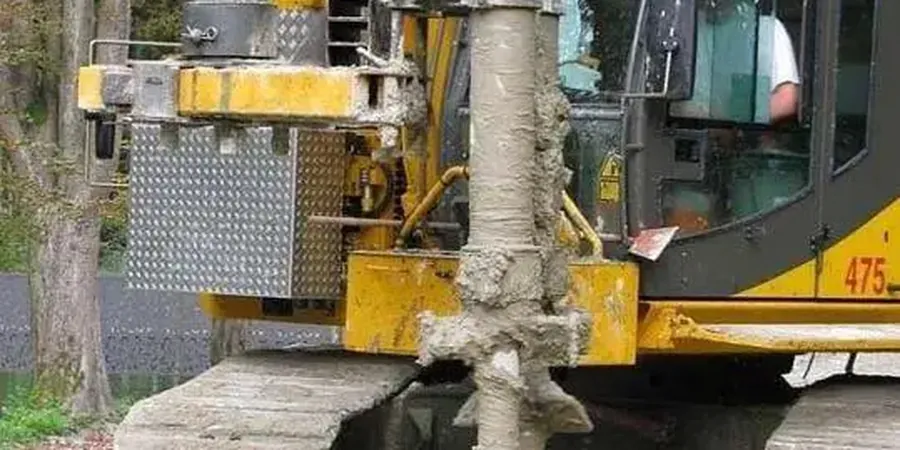
Deep soil mixing design transforms loose alluvium into a stiff, low-permeability mass, reducing settlement risks and liquefaction potential under seismic loading.
Service characteristics in Las Vegas
- Binder dosage optimized per ASTM D1633 for unconfined compressive strength targets
- Wet or dry mixing depending on natural moisture content
- Column diameters from 0.6 m to 2.4 m for varying load demands
Critical ground factors in Las Vegas
Las Vegas sits at an elevation of 2,000 feet and lies within Seismic Design Category C under IBC 2021, with a peak ground acceleration of 0.21g for the 2% in 50-year event. The loose alluvial sands and silts that cover much of the valley are susceptible to liquefaction under moderate shaking, especially where the water table rises during wet winters. Without deep soil mixing design, a magnitude 6.5 earthquake on the nearby Eglington fault could trigger widespread lateral spreading beneath strip foundations and utility corridors. The treated columns act as shear keys that break the liquefaction cycle by reducing void ratio and increasing confinement. We also evaluate settlement from collapsible soils using double-oedometer tests before finalizing the DSM grid pattern.
Our services
Our deep soil mixing design service covers the full project cycle, from preliminary feasibility to construction verification. Each phase is tailored to Las Vegas soil conditions and local code requirements.
Feasibility and Binder Optimization
We test representative soil samples with candidate binders (cement, slag, fly ash) to determine the optimum dosage for strength and permeability targets. Results follow ASTM D1633 and are reported within two weeks.
Column Layout and Structural Design
Using finite-element models (PLAXIS 2D/3D) we define column diameter, spacing, and depth to meet allowable settlement and bearing capacity under service loads. We incorporate seismic demands per ASCE 7.
Construction Monitoring and QA/QC
During installation, we monitor binder flow rate, rotation speed, and withdrawal rate in real time. Wet grab samples are taken every 20 columns for unconfined compression testing at 7 and 28 days.
Post-Treatment Verification Testing
We perform full-length coring and pressuremeter tests in treated columns to confirm uniformity and strength. Results are compared against design targets and reported with statistical confidence intervals.
Frequently asked questions
What types of soil in Las Vegas benefit most from deep soil mixing design?
Loose alluvial sands, silts, and collapsible soils common along the Las Vegas Valley floor respond very well. DSM transforms these weak deposits into a stiff, low-permeability mass that supports moderate to heavy loads without excessive settlement.
How does deep soil mixing design reduce liquefaction risk in Las Vegas?
The treated columns replace loose granular soil with a cemented matrix that resists shear strain during shaking. This breaks the pore-pressure buildup cycle and prevents lateral spreading. The improvement is especially valuable near the Eglington fault zone.
What is the typical cost range for deep soil mixing design in Las Vegas?
Design and verification costs for a typical project range from US$1,710 to US$5,600, depending on the number of columns, binder testing, and QA/QC requirements. Construction costs are additional and vary by volume.
Which codes govern deep soil mixing design in Las Vegas?
We follow IBC 2021, ASCE 7-22 for seismic loads, and FHWA-HRT-13-046 for DSM design methodology. Laboratory tests adhere to ASTM D1633 for strength and ASTM D2487 for soil classification.