The arid climate of Las Vegas, with less than 4 inches of annual rainfall, creates a unique challenge for subsurface exploration. In our experience, the near-surface soils here—often a mix of alluvial sands, silts, and caliche layers—can mask deeper conditions that only a properly excavated exploratory test pit can reveal. When you need to see the soil profile directly, verify bearing strata, or identify perched groundwater after rare heavy rain events, a test pit provides the clearest picture. This method is especially valuable before designing shallow foundations or utility trenches in the Las Vegas Valley, where ancient lakebed deposits (the Lake Mead formation) can vary dramatically within a single block. We follow ASTM D420 and D2488 standards to ensure every test pit yields actionable data for engineers and contractors.
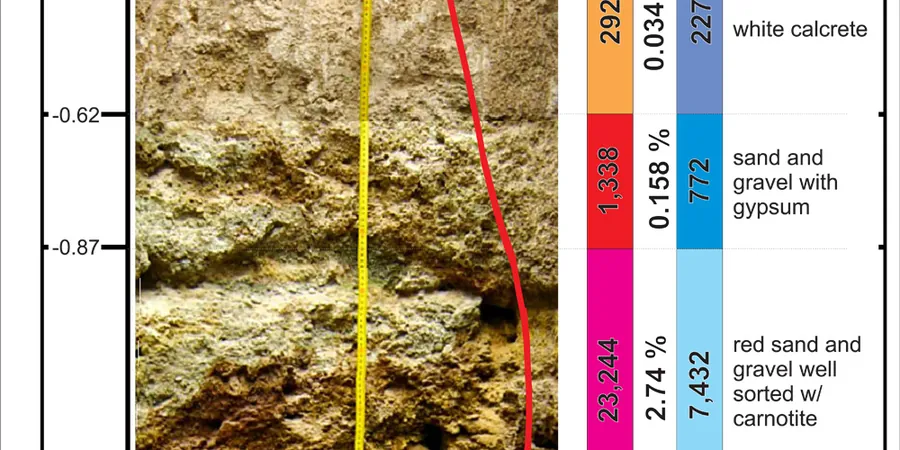
In Las Vegas, a test pit reveals caliche layers and ancient lakebed deposits that geophysics can miss, saving costly redesigns.
Service characteristics in Las Vegas
Critical ground factors in Las Vegas
A common error we see from contractors in Las Vegas is assuming that a few SPT borings are enough to characterize a site. The problem is that the near-surface geology here includes discontinuous caliche pans and paleochannels—features that can vary laterally by less than 20 feet. If you only rely on borings and miss a caliche layer that acts as a false bearing stratum, your foundation could settle unevenly when the caliche dissolves or fractures under load. We have personally witnessed a strip mall near Summerlin where differential settlement exceeded 2 inches because a test pit was skipped. The exploratory test pit is the only direct method to see these features before you pour concrete.
Our services
We complement field test pits with laboratory and in-situ testing to complete the geotechnical picture for Las Vegas projects.
Test Pit with Bulk Sampling
Excavation to target depth, full profile logging, and collection of bulk samples for laboratory classification (moisture content, Atterberg limits, sieve analysis). Suitable for residential and light commercial sites where shallow conditions are critical.
Test Pit with Undisturbed Block Sampling
For projects requiring intact soil specimens—such as retaining wall design or slope stability analysis—we extract hand-carved block samples from test pit walls. These are sealed, transported, and tested for shear strength or consolidation per ASTM D4220.
Frequently asked questions
How deep can an exploratory test pit go in Las Vegas?
We typically excavate to 15 feet (4.5 m) using a standard backhoe. For deeper requirements, we can coordinate with track-hoe equipment to reach 20-25 feet, though groundwater or collapsing sands may limit depth. Most residential and commercial projects in the Las Vegas Valley only need 10-15 feet to reach competent bearing strata.
What is the difference between a test pit and a boring?
A test pit provides direct visual observation of the soil profile, including color, moisture, root holes, and caliche lenses. A boring (SPT) gives you a continuous 2-inch diameter core with penetration resistance numbers. Test pits are superior for detecting lateral variability and for collecting large bulk samples, while borings are better for deep profiles and quantitative strength parameters.
When should I choose a test pit over other exploration methods?
Choose a test pit when you need to verify shallow bearing capacity, locate underground utilities, or assess backfill quality. It is also the best method for identifying the depth and extent of caliche layers, which are common in the Las Vegas area and can cause foundation issues. For deep foundations or high-rise towers, we recommend combining test pits with SPT borings.
What permits are needed for test pits in Clark County?
Clark County requires a right-of-way permit if the pit is within the street or sidewalk area. On private property, no permit is needed for pits shallower than 5 feet, but we always notify the local utility marking service (NV Energy, Southwest Gas) 48 hours before digging. For pits deeper than 5 feet, a confined space entry plan is mandatory per OSHA.
How much does an exploratory test pit cost in Las Vegas?
The typical cost ranges from US$510 to US$960 per pit, depending on depth, equipment access, and whether you need bulk or undisturbed sampling. This includes mobilization within the Las Vegas metropolitan area, excavation, field logging, and basic laboratory classification. For multiple pits or remote sites (e.g., Pahrump or Laughlin), add a mobilization fee.