We recently worked on a hotel expansion near the Strip where the structural engineer needed in situ proof of bearing capacity before pouring a mat foundation. The soil profile there — a mix of silty sands and gravelly alluvium — can vary significantly within a single lot. Running a plate load test (PLT) directly on the bearing stratum gave the team real numbers instead of relying solely on empirical correlations. That kind of certainty is especially valuable when you are dealing with shallow footings for mid-rise buildings. For deeper verification we often combine the PLT with an ensayo SPT to cross-check penetration resistance against the measured bearing pressure.
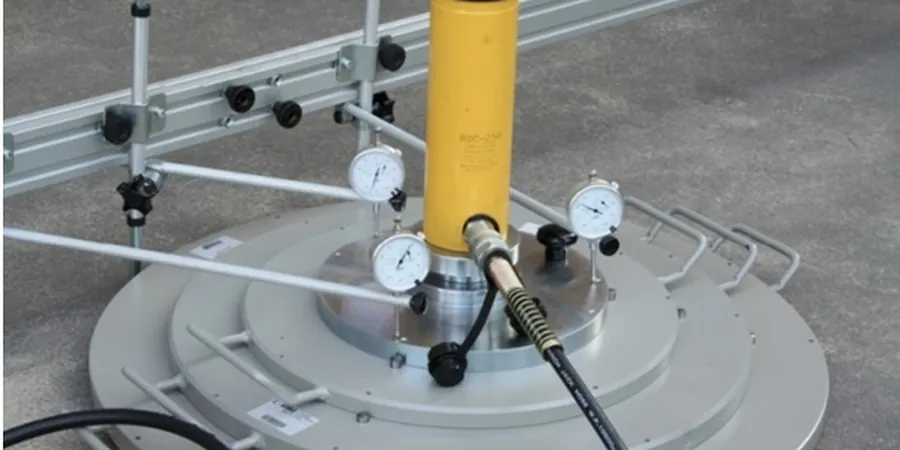
The plate load test gives you the modulus of subgrade reaction directly — no guesswork — which is critical for settlement-sensitive structures in collapsible alluvial soils.
Service characteristics in Las Vegas
Critical ground factors in Las Vegas
The biggest risk we see in Las Vegas is assuming the bearing capacity from a soils report based solely on blow counts without a field verification. IBC 2021 requires a factor of safety of 2.0 for allowable bearing pressure, but if the soil is collapsible — common in the western valley — a PLT after wetting can reveal a 50% reduction in capacity. That is why we always flag the need for a plate load test when the project footprint sits on undocumented fill or where moisture content could change during construction. For slope-adjacent lots, we also evaluate estabilidad de taludes because the bearing pressure near an excavation face behaves differently.
Our services
Beyond the standard plate load test, we offer complementary services that integrate with your foundation design workflow in Las Vegas.
In-Situ Bearing Verification
Plate load test performed at design subgrade elevation with hydraulic jack and calibrated load cell. We provide load-settlement curves, modulus of subgrade reaction (k), and ultimate bearing capacity. Results delivered within 48 hours.
Pre- and Post-Compaction Verification
For fills and compacted subgrades, we combine the PLT with sand cone density tests to confirm that compaction meets project specs before the foundation is poured. Especially useful in Las Vegas where fill thickness can exceed 10 feet.
Wet Test for Collapsible Soils
If the project site is in a known collapsible soil zone (e.g., near Red Rock Canyon or the western valley), we flood the test area before loading to simulate worst-case moisture conditions. This is the only reliable way to quantify collapse potential under design loads.
Frequently asked questions
What is the difference between a plate load test and a standard penetration test (SPT)?
The PLT directly measures the soil's bearing capacity and settlement under a rigid plate at the actual foundation depth. The SPT gives you an indirect measure of soil resistance via blow counts. Both are useful, but the PLT is the only way to get the modulus of subgrade reaction (k) for settlement-sensitive designs. Many engineers in Las Vegas use SPT for preliminary profiling and then confirm with a PLT at critical locations.
How much does a plate load test cost in Las Vegas?
A standard plate load test in Las Vegas typically ranges between US$850 and US$1,430, depending on the number of test locations, depth of excavation, and whether a wet test is required. For large commercial projects with multiple plates, the per-test cost decreases. Contact us for a site-specific quote.
What size plate do you use, and does it match the actual footing size?
We use a 30-inch diameter plate as per ASTM D1196, which is standard for shallow footings up to about 5 feet in width. For larger footings, we extrapolate the results using elastic theory. The test is not meant to replicate the full footing geometry, but to give a representative modulus of subgrade reaction and bearing capacity for the soil mass under the plate.
Can I perform a plate load test on a slope or near an excavation?
Yes, but with precautions. The test plate must be at least 5 feet away from the edge of the excavation to avoid edge effects. If the slope is steeper than 2H:1V, we recommend a slope stability analysis first. We can also place the test at the base of the excavation if the footing will be at that depth.
How long does it take to get the results?
The field test itself takes 2 to 4 hours per cycle. Data processing and the final report — including load-settlement curves and calculated parameters — are typically delivered within 48 hours. For projects on a tight schedule, we can expedite to next-day delivery for an additional fee.