The contrast between the alluvial fans of Red Rock Canyon and the flat clay pans near Nellis Air Force Base sums up Las Vegas slope challenges. In the northwest, weathered debris flows demand high factors of safety; in the valley center, expansive clays crack under seasonal wetting. Our team approaches each slope stabilization design in Las Vegas with site-specific shear strength data from direct shear and triaxial tests. Without that local calibration, the risk of shallow failures in the caliche crust or deep-seated slides in the old lakebed deposits goes unaddressed. We combine field exploration with a calicatas exploratorias program to map subsurface stratigraphy before modeling any slope.
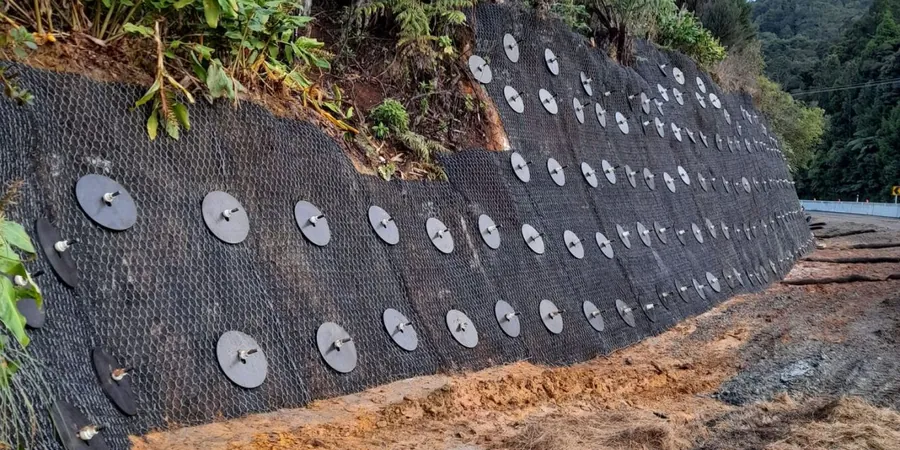
In Las Vegas collapsible soils, ignoring the post-wetting shear strength reduction can turn a stable slope into a debris slide within one monsoon season.
Service characteristics in Las Vegas
Critical ground factors in Las Vegas
Las Vegas sits at an elevation of 610 m in the Mojave Desert, receiving less than 110 mm of rain per year. That aridity creates a dangerous paradox: dry slopes appear stable until a sudden thunderstorm saturates the collapsible soils. Our slope stabilization design in Las Vegas must account for rapid strength loss in the upper 3–5 m. The 1999 Paradise flood event triggered dozens of slope failures along the western escarpments. We use unsaturated soil mechanics and transient seepage analysis to model wetting fronts. Without that, the factor of safety can drop from 1.6 to 0.9 in a matter of hours.
Our services
We offer two specialized service lines for slope stabilization design in Las Vegas, each tailored to the local geology and regulatory framework.
Numerical Slope Modeling & Limit-Equilibrium Analysis
Using Slide2 and FLAC2D, we model both circular and non-circular failure surfaces. We input site-specific strength parameters from our own triaxial tests. Output includes factor of safety for static, seismic, and transient seepage conditions. We also perform parametric studies on reinforcement alternatives.
Reinforcement & Drainage Design
We design soil nails, anchored walls, and drainage blankets that work with Las Vegas caliche and loose fills. Each design includes corrosion protection for steel elements (caliche is aggressive) and a surface water management plan to prevent infiltration into the failure zone.
Frequently asked questions
What is the typical cost range for a slope stabilization design in Las Vegas?
For a standard residential or commercial slope up to 10 m high, the design and testing package runs between US$1,560 and US$6,860. This includes field exploration, lab testing, numerical modeling, and a stamped report. The final cost depends on slope height, accessibility, and the number of reinforcement alternatives evaluated.
How long does a slope stabilization design take in Las Vegas?
A typical project takes 4 to 8 weeks from field mobilization to report delivery. The schedule depends on the number of borings and test pits required. In Las Vegas, we can often drill through the caliche crust quickly with rotary methods, which keeps field time shorter than in hard-rock terrain.
What soil conditions in Las Vegas are most critical for slope stability?
Collapsible soils and expansive clays are the two most critical conditions. Collapsible soils lose strength dramatically when wetted, while expansive clays cause cyclic swelling and shrinking that can crack the slope surface. Both require unsaturated soil testing and long-term monitoring of pore pressures.
Do I need a slope stabilization design if the slope has been stable for years?
Yes, especially in Las Vegas. A slope that appears stable in dry conditions can fail within hours of a rare storm. The 1999 Paradise flood demonstrated this clearly. A proper design quantifies the factor of safety under saturated conditions and identifies potential failure surfaces that are invisible on the surface.
What reinforcement methods work best for Las Vegas slopes?
Soil nails and anchored walls perform well in the granular alluvial fans. For slopes in fine-grained colluvium, we often recommend a combination of drainage blankets and deep soil mixing with lime or cement. Each method must account for the aggressive chemical environment of the caliche layers, so we specify corrosion-resistant steel or PVC encapsulation.